What Is Nikah? The Islamic Marriage Contract Explained
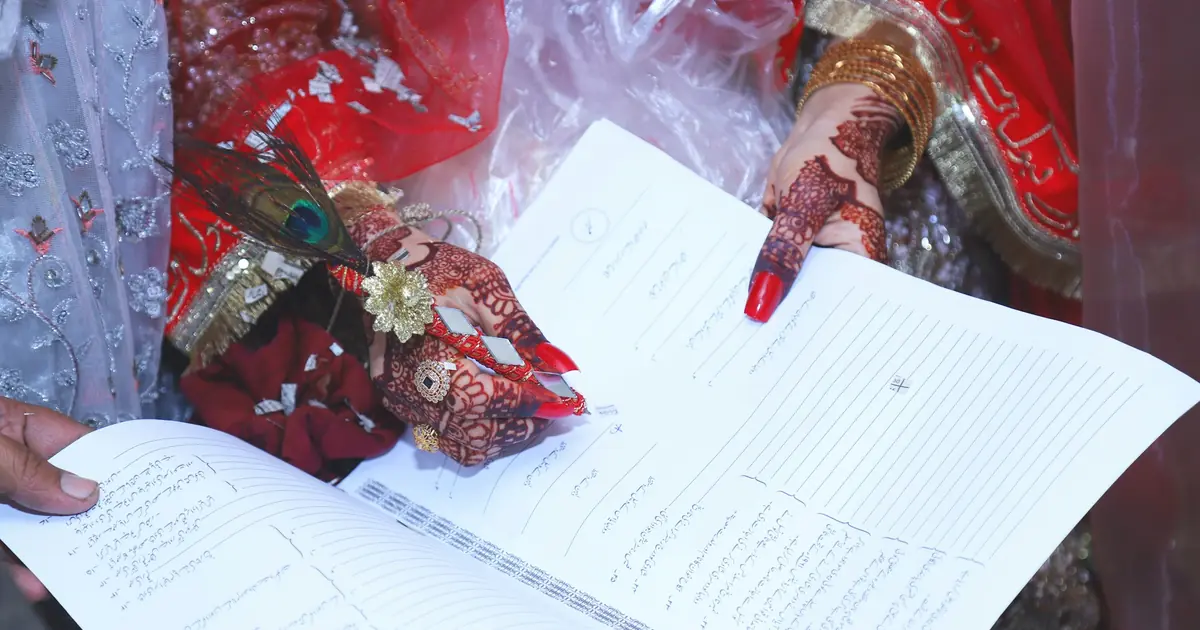
Nikah is the Islamic marriage contract — a legal agreement between husband and wife with clearly defined mutual rights and obligations, not just a social custom. It requires an offer, acceptance, Mahr, and free consent, and its ruling ranges from recommended to obligatory depending on a person's circumstances. The moment a Nikah is valid, husband and wife also become each other's fixed heirs under Faraid.
What Is Nikah?
Nikah (نكاح) is the Islamic marriage contract — a legal 'aqd (agreement) between two people, with defined rights and obligations on both sides, rather than a sacrament in the way marriage is sometimes described in other traditions. It's also framed in the Quran in unmistakably relational terms:
وَمِنْ آيَاتِهِ أَنْ خَلَقَ لَكُمْ مِّنْ أَنفُسِكُمْ أَزْوَاجًا لِّتَسْكُنُوٓا إِلَيْهَا وَجَعَلَ بَيْنَكُم مَّوَدَّةً وَرَحْمَةً
"And of His signs is that He created for you from yourselves mates that you may find tranquility in them, and He placed between you affection and mercy." — Surah Ar-Rum 30:21. The contract's legal structure and its emotional purpose are described in the same breath — one doesn't replace the other.
Is Marriage Obligatory in Islam?
There's no single answer — the ruling shifts with the person's own circumstances, not a fixed rule applied identically to everyone. Marriage becomes obligatory for someone who fears falling into sin without it and has the means to marry. For the average person with genuine desire and the means to support a spouse, it's strongly recommended — the Prophet ﷺ said: "O young men, whoever among you can afford it, let him marry... whoever cannot afford it, let him fast, for it will diminish his desire" (Sahih al-Bukhari, Sahih Muslim). Beyond that, it can be neutral, disliked, or even discouraged depending on someone's ability to actually fulfil what marriage requires of them.
The Conditions for a Valid Nikah
Four things are agreed across all four Sunni madhabs, with one genuine point of difference:
- Offer and acceptance (Ijab and Qabul): a clear, unambiguous exchange, in one sitting.
- Mahr: a mandatory right of the bride, owed by the groom. Quran 4:4: "And give the women [upon marriage] their dower as a gift." See What Is Mahr? for the full picture — prompt vs. deferred, who owns it, what happens if it's never paid.
- Free consent of both parties: a marriage contracted under coercion is invalid in the majority view. A well-known report describes a woman coming to the Prophet ﷺ to say her father had married her off without her consent, and being given the choice to annul it.
- Wali (guardian) and two witnesses: most schools — Shafi'i, Hanbali and Maliki — require a wali for the bride's marriage to be valid, alongside two witnesses. The Hanafi school takes a more permissive position on the wali requirement, allowing a sane adult woman to contract her own marriage in some circumstances. This is a real, acknowledged difference between the madhabs, not a single settled rule everyone follows the same way.
Work Out the Mahr Amount
If the Mahr was agreed as a weight of gold, get today's value instantly — mark it as prompt or deferred.
Open the Mahr Calculator →Rights and Responsibilities: Husband and Wife
A Nikah contract runs in both directions. The husband owes his wife Mahr, Nafaqah (maintenance — food, clothing and shelter appropriate to his means, per Quran 65:7 and 2:233), and kind treatment: "live with them in kindness" (Quran 4:19), reinforced by the hadith "the best of you are those who are best to their wives" (Tirmidhi). Where he has more than one wife, he owes each of them fair, equal treatment (Quran 4:3, 4:129). The wife, in turn, owes obedience within Islamic bounds — never in matters of sin — and safeguarding her husband's property and honour in his absence (Quran 4:34).
One point is easy to miss and worth stating plainly: a wife's wealth, income and property remain entirely her own under Islamic law. The husband has no claim to it, and she isn't obligated to spend her own money on the household even if she chooses to. This is why FaraidHub treats husband and wife as two completely separate estates rather than one pooled "marital estate" — a real point of confusion for anyone coming from a community-property legal system where marital assets are assumed to merge automatically.
Nikah, Inheritance and Wasiyyah
The moment a Nikah is valid, husband and wife become each other's fixed Quranic heirs — a wife receives 1/4 of her husband's estate if there are no children, or 1/8 if there are; a husband receives 1/2 or 1/4 under the same condition. See Wife's Share in Islamic Inheritance and Husband's Share in Islamic Inheritance for the full mechanics. This right exists automatically, independent of any will, for as long as the marriage remains valid.
Because a spouse is already a fixed heir, the usual Wasiyyah rule applies to them exactly as it does to a child — a will cannot top up or redirect their share beyond what Faraid already gives, unless every other heir agrees. This trips people up more than almost anything else on this site: many assume a will can simply leave "everything to my spouse," and Islamic law restricts that. Separately, any Mahr still owed when a husband dies doesn't disappear — it becomes a debt against his estate, paid before Wasiyyah and Faraid are even calculated, the same first-priority treatment as funeral costs and ordinary debts (see What Is Paid Before Inheritance?). Beyond the legal mechanics, much of what a couple builds together — raising righteous children, a shared waqf, funding each other's education — is commonly counted as Sadaqah Jariyah, reward that keeps accruing to both of them long after either has passed.