Islamic Inheritance Guide
A step-by-step walkthrough of how Faraid distribution actually works: identifying heirs, fixed shares, blocking rules and the adjustments that keep the numbers exact, with a link to the detailed article for every variation along the way.
Once funeral costs, debts and any Wasiyyah are settled, Faraid distributes what remains in two stages: heirs with fixed Quranic shares (Ashab al-Furud) receive their fraction first, then any residue passes to residuary heirs (Asabah). Blocking rules (Hajb) determine who's eligible in the first place, and Awl or Radd correct the arithmetic when the fixed fractions don't add up to exactly the whole estate. This guide walks through each stage, and links to the full article for every variation and edge case.
Why This Guide Exists
Our Janazah & Estate Guide covers what to do after a death, from the funeral through to a single step that says, in effect, "now use the calculator." That's the right amount of detail for a family in the days after a loss, but it skips over how Faraid itself actually works, and the site has a lot more to say about that than one paragraph can hold.
This guide picks up exactly where that one leaves off. It's not a calculator, and it doesn't ask for any numbers: it explains the logic Faraid follows, step by step, and at every step it points you to the full article covering that step's variations and edge cases: which heirs apply to your family, which madhab you follow, and what happens in the less common cases.
Step 1: Confirm the Estate Is Ready for Distribution
Faraid only applies to what's left of the estate after three things are settled, in order: funeral and burial costs, all outstanding debts (to people and to Allah), and any valid Wasiyyah: a bequest capped at one-third of what remains, and only to someone who isn't already a Faraid heir. Distributing anything before this order is followed isn't just premature, it can mean redoing the whole calculation once a forgotten debt or bequest surfaces.
See the full breakdown of what counts as a debt, and the exact order funeral costs, debts and Wasiyyah are paid in.
Read: What Is Paid Before Inheritance? →If a Wasiyyah exists, it needs to be valid, written, within the one-third cap, and not directed at someone who already has a fixed Faraid share, before it's paid out.
Not written one yet, or checking whether an existing one is valid? See how to write a Shariah-compliant Islamic will.
Read: How to Write an Islamic Will →If you're reading this in the days right after a loss and haven't yet worked through the funeral and Ta'ziyah stage, our Janazah & Estate Guide covers that ground in full before you get here.
Step 2: Identify the Deceased's Faraid Heirs
Faraid heirs are a fixed, Quran-defined group, not every blood relative, and not a list the deceased gets to edit. They fall into two main categories: Ashab al-Furud (fixed-share heirs: spouse, children, parents, and some grandparents and siblings under specific conditions) and Asabah (residuary heirs, who take whatever remains after fixed shares are paid, typically the closest male agnate relatives).
Exactly what a given heir receives depends heavily on who else survives: a wife's share changes depending on whether there are children, a father's share changes depending on whether there's a son, and so on. Rather than restate every scenario here, each relation has its own dedicated article with every case worked out:
- Wife's Share in Islamic Inheritance
- Husband's Share in Islamic Inheritance
- Son's Share in Islamic Inheritance
- Daughter's Share in Islamic Inheritance
- Father's Share in Islamic Inheritance
- Mother's Share in Islamic Inheritance
- Siblings' Share in Islamic Inheritance
For the full picture of how the fixed-share and residuary systems fit together, start with our foundation article on Faraid itself.
Read: What Is Faraid? →Step 3: Apply the Blocking Rules (Hajb)
Not everyone on the list of possible heirs actually inherits: Hajb is the set of rules that blocks a more distant relative when a closer one survives, or reduces (without eliminating) a share when a specific relative is present. A son, for instance, blocks his own children and his siblings from inheriting directly; a father's presence reduces a mother's share from 1/3 to 1/6 in some cases, without ever removing it. Six heirs can never be fully blocked under any circumstance: the husband, wife, son, daughter, father, and mother.
See exactly who blocks whom, who's only partially reduced, and the six heirs who are never blocked.
Read: Hajb and Blocking Rules Explained →Step 4: Assign the Fixed Quranic Shares
Once the eligible heirs are identified, each Ashab al-Furud heir is assigned their fixed fraction: one of six fractions set out directly in Surah An-Nisa (1/2, 1/4, 1/8, 2/3, 1/3, or 1/6), depending on their relationship to the deceased and who else survives. Anything left over after every fixed share is paid passes to Asabah (residuary) heirs, most often the son, or the father acting in his residuary capacity when no son survives.
Read the actual verses these fractions come from, with the classical commentary on how each phrase is applied.
Read: Surah An-Nisa Inheritance Verses →Step 5: Correct for Awl or Radd
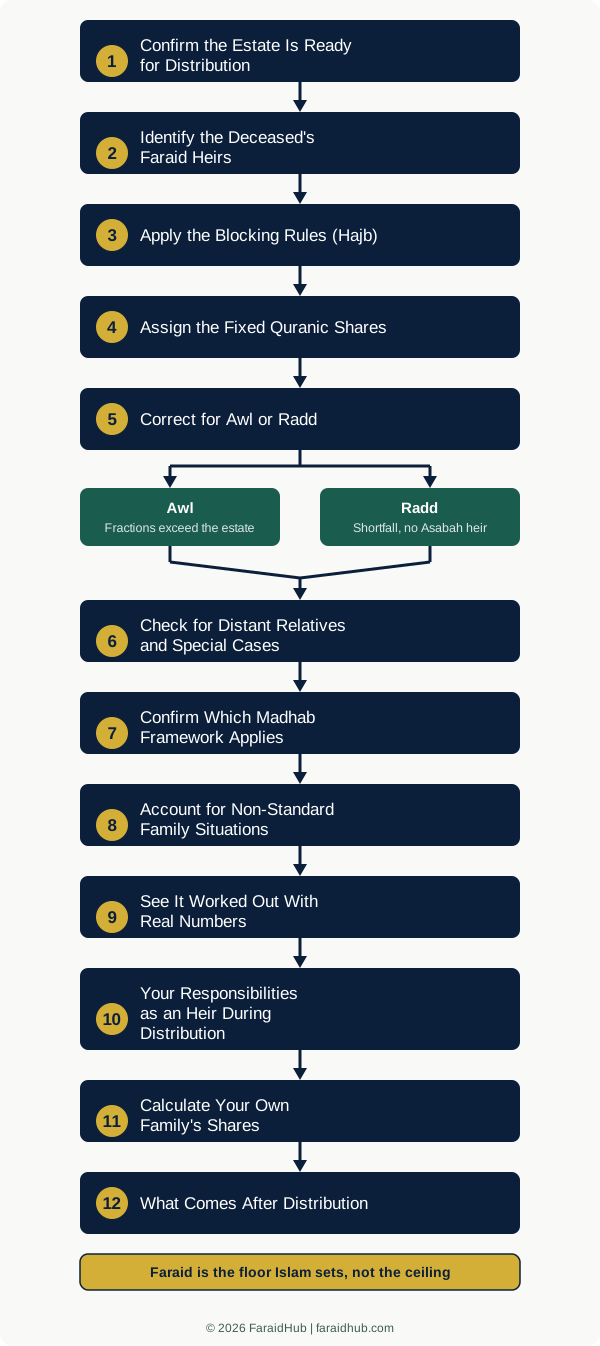
Because the fixed fractions were each set independently in the Quran, adding them all up for a specific family doesn't always land on exactly 100% of the estate. Two mechanisms correct this. Awl proportionally reduces every heir's share when the fractions add up to more than the whole estate: everyone still receives their share, just slightly smaller than the nominal fraction. Radd returns the surplus proportionally to eligible heirs when the fractions add up to less than the whole estate and no Asabah heir exists to absorb the rest.
See worked examples of Awl proportionally reducing every share when the fractions exceed 100%.
Read: Awl Explained →See who qualifies for Radd, and the specific point where the Maliki school treats a surviving spouse differently.
Read: Radd Explained →Step 6: Check for Distant Relatives and Special Cases
Two situations fall outside the standard fixed-share-then-residue process. When there are no children and no parents, the case is called Kalalah, and it specifically changes how siblings inherit. When there's no Ashab al-Furud heir and no Asabah heir at all (a rarer situation), more distant relatives known as Dhawul Arham become eligible; the presence of even one child usually rules this out entirely. A small number of named, famous combinations (Umariyyatayn, Mushtaraka and Akdariyyah) also produce results that don't follow the standard formula in the obvious way, and are worth knowing by name if your own case looks unusual.
See who counts as Dhawul Arham, and exactly when they become eligible to inherit.
Read: Dhawul Arham Explained →See how Kalalah changes sibling shares, with the two Quranic verses it comes from.
Read: Kalalah Explained →See Umariyyatayn, Mushtaraka and Akdariyyah worked out across all four madhabs.
Read: Special Cases in Islamic Inheritance →Step 7: Confirm Which Madhab Framework Applies
The Hanafi, Maliki, Shafi'i and Hanbali schools agree on the core Quranic fractions and the overall order of the estate process: the differences are real, but narrower than people often expect. Where they diverge is in specific details within Faraid itself: some Radd rules, how a grandfather is treated when siblings also survive, and a handful of distant-relative and special cases. Knowing which madhab your family follows (or which your country's Faraid courts apply) matters most exactly in these edge cases.
Compare all four schools side by side, with the specific points where they actually disagree.
Read: The 4 Madhabs Explained →For the complete rules of one specific school in one place: Hanafi, Maliki, Shafi'i, and Hanbali.
Step 8: Account for Non-Standard Family Situations
A few common real-world situations change the calculation in ways worth knowing about before you assume the standard case applies: more than one wife surviving, daughters inheriting with no surviving sons, and whether a surviving spouse actually has the right to keep living in the family home rather than see it sold and split immediately.
- Multiple Wives: Inheritance Rights in Islam
- Only Daughters and No Sons in Islamic Inheritance
- Can Your Spouse Keep the Family Home in Islam?
Step 9: See It Worked Out With Real Numbers
Every step above makes more sense once you've seen it applied to an actual family and an actual estate value. Our worked-example article runs through several full scenarios by hand (daughters only, no children at all, an Awl case, a Radd case and multiple wives), showing every fraction and every number, not just the final split.
Follow a complete Faraid calculation by hand, step by step, across five different family scenarios.
Read: Step-by-Step Faraid Calculation →Step 10: Your Responsibilities as an Heir During Distribution
Being an eligible heir carries a few responsibilities of its own, beyond simply receiving a share once the arithmetic is done. Confirm every debt is genuinely accounted for before anything is paid out: reopening a distribution because a debt surfaced afterward is far harder than delaying it a few weeks up front. Where the estate includes something illiquid, like a business or the family home, don't assume it splits as cleanly as cash; get an independent valuation before agreeing to a buyout or a sale. And don't treat Faraid as automatically sufficient on its own: in most countries you're also responsible for whatever legal process actually transfers title.
See the full list of recurring mistakes families make when distributing an Islamic estate, and how to avoid each one.
Read: Common Mistakes in Islamic Estate Distribution →On that last responsibility specifically: Faraid governs the religious obligation, but most countries still require a legally valid will or probate process to actually transfer title, and the two systems don't always align automatically. Check the guide for your own country before assuming Faraid alone is sufficient:
Step 11: Calculate Your Own Family's Shares
Everything above explains the logic. Working out the actual numbers for a specific family and a specific estate value is where a calculator earns its keep: the arithmetic is straightforward once you know the rules, but easy to get wrong by hand, especially once Awl, Radd or a blocking rule is involved.
Enter your net estate and surviving heirs to get each person's exact Faraid share, with the reasoning shown for every figure, across all four madhabs.
Open the Inheritance Calculator →If you're planning ahead rather than distributing an existing estate, preparing an Islamic will now, within the Wasiyyah rules covered in Step 1, is the simplest way to make this whole process easier for the people you leave behind.
Create a Shariah-compliant Islamic will in minutes, ready to print and witness.
Open the Will Generator →Step 12: What Comes After Distribution
Faraid is the floor Islam sets, not the ceiling. Once an estate is correctly distributed, some families find that gifting during one's lifetime (Hibah) or a family endowment (Waqf) achieves something Faraid alone can't: directing wealth toward a specific need, or keeping an asset like a business intact across generations instead of fragmenting it. Neither replaces Faraid; both sit alongside it as separate, voluntary tools for planning ahead, ideally arranged well before they're needed.
See how Hibah, Wasiyyah and Faraid differ, and when each one is the right tool.
Read: Hibah vs. Wasiyyah vs. Faraid →The Full Process at a Glance
All twelve steps above, in order, including the Awl/Radd fork at Step 5, since the fixed fractions can land either over or under 100% of the estate depending on the family.
Free Download
Islamic Inheritance Guide (PDF)
Keep this guide on hand: print it, save it, or share it with family when they need it.
Download PDF GuideFrequently Asked Questions
Our editorial team comprises Islamic finance specialists and estate planning professionals dedicated to making Faraid knowledge accessible to Muslims worldwide.